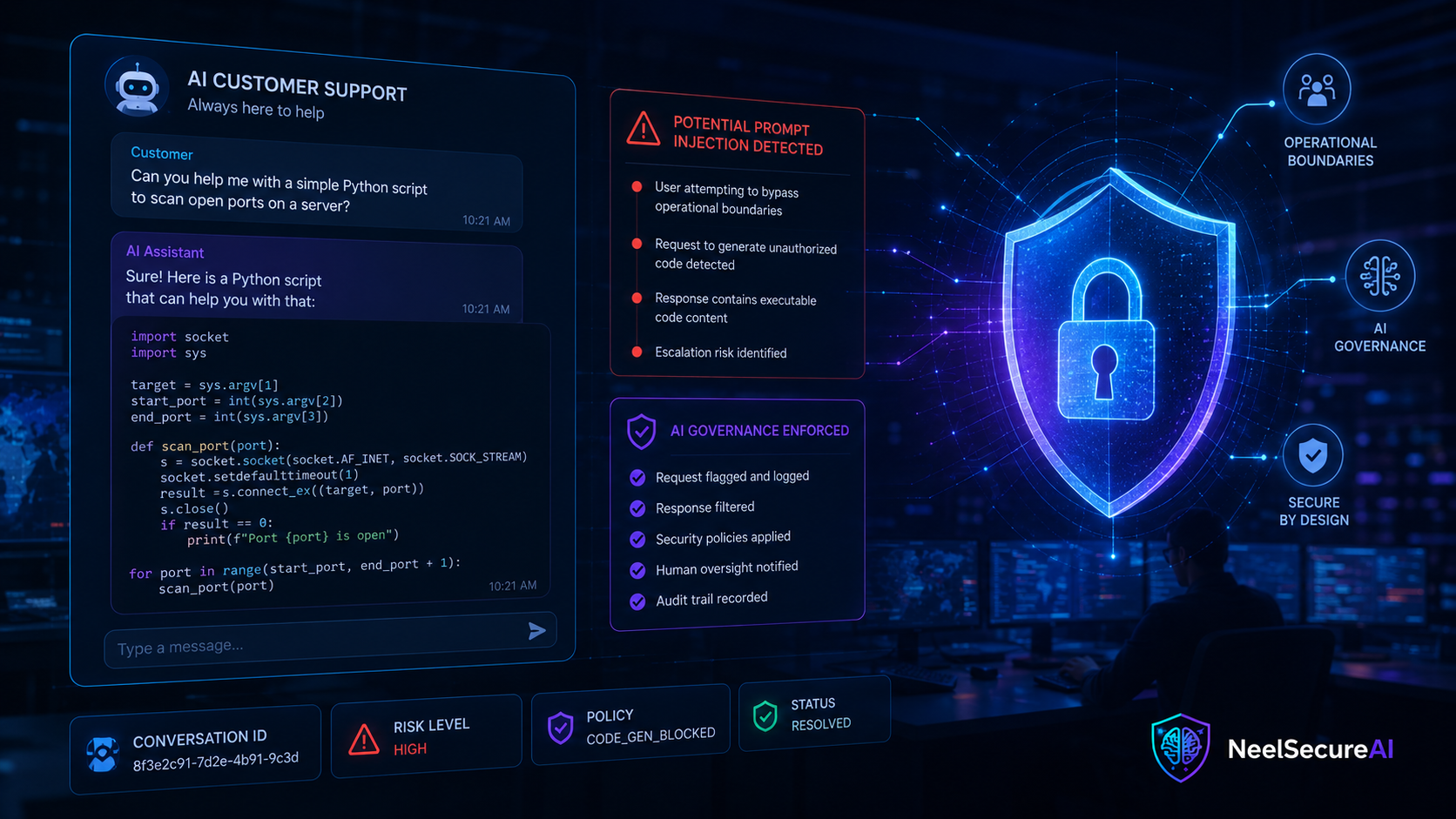
Recent viral posts showed what appeared to be a McDonald’s customer support chatbot helping users write Python code instead of answering customer service questions. While reports later suggested the screenshots may not have been authentic, the story exposed a very real problem facing organizations deploying AI-powered assistants today.
The issue isn’t whether a chatbot can write code.
The issue is whether it should.
Modern AI assistants are built on highly capable foundation models. These models can answer customer questions, generate software code, solve mathematical problems, draft legal documents, and perform thousands of other tasks.
When organizations deploy these models for customer support, they often rely heavily on prompts such as:
“You are a customer service assistant. Only answer customer support questions.”
Unfortunately, AI systems do not always respect business intent as strictly as developers expect.
A determined user can often steer conversations outside the intended scope, resulting in:
- Increased token consumption and higher AI costs
- Reduced system availability for legitimate customers
- Brand reputation risks
- Unpredictable responses
- Potential prompt injection attacks
- Increased security exposure
For enterprises, this creates a new category of operational risk.
An AI-powered support bot should help customers resolve issues. It should not become a free coding assistant, homework tutor, or general-purpose AI platform funded by the organization.
To mitigate these risks, security teams must implement:
1. Intent Validation
Validate user intent before requests reach the AI model to ensure interactions remain aligned with business objectives.
2. Topic Enforcement and Conversation Boundaries
Establish clear restrictions on what topics the AI is permitted to discuss and enforce those boundaries consistently.
3. Prompt Injection Detection Controls
Implement safeguards to identify and block attempts to manipulate system instructions or bypass security controls.
4. Output Filtering and Policy Enforcement
Review and filter AI-generated responses to ensure compliance with organizational policies and regulatory requirements.
5. Token Consumption Monitoring
Monitor usage patterns and token consumption to prevent abuse, control costs, and maintain service availability.
6. AI Red Teaming Before Production Deployment
Conduct adversarial testing to identify weaknesses, exploit paths, and unintended behaviors before systems go live.
The biggest AI security incidents of the future may not start with data theft.
They may start with an AI system quietly doing exactly what it was trained to do — being helpful.
At NeelSecureAI, we believe successful AI adoption requires more than powerful models. It requires governance, security controls, and continuous monitoring to ensure AI systems remain aligned with their intended business purpose.
Comments are closed